In This Article
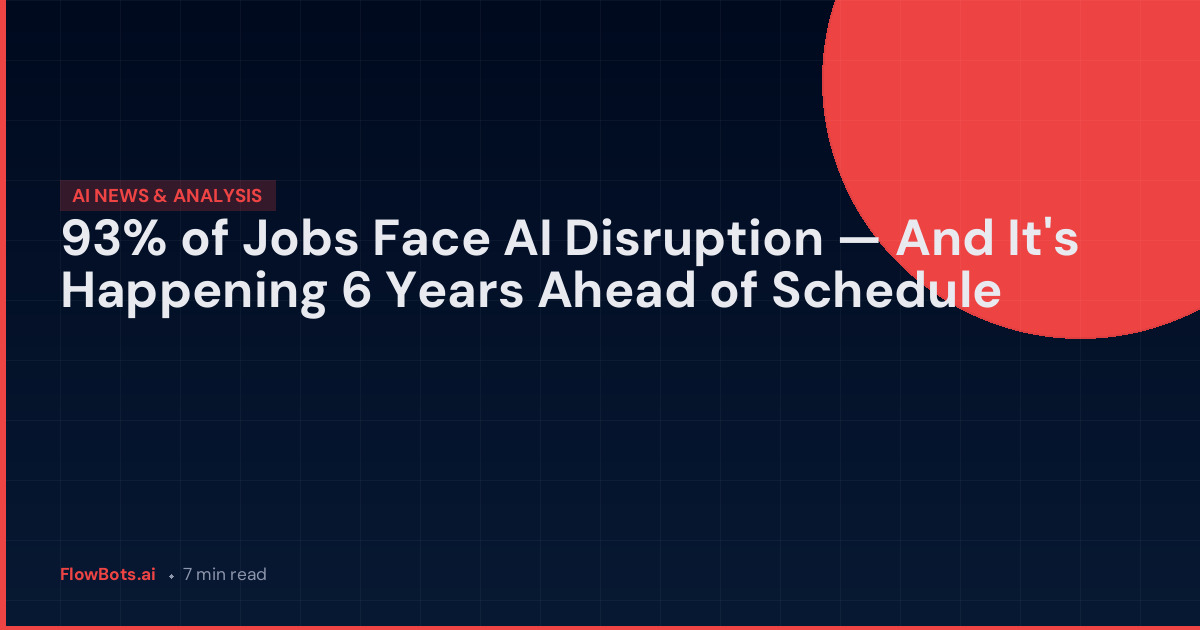
March 19, 2026. A bombshell report from Cognizant dropped this week, and the numbers should stop every business owner in their tracks: 93% of all jobs now face some level of AI disruption, with 30% facing an existential threat. That existential figure is 15 percentage points higher than Cognizant originally forecast, and arriving six years ahead of schedule. As Cognizant’s researchers put it: “What we projected might take until 2032 is happening now.”
Key Takeaways
- 93% of all jobs now face measurable AI disruption, with 30% facing existential transformation, arriving six years ahead of Cognizant’s original 2032 forecast.
- A $4.5 trillion productivity shift is already underway, flowing to businesses that adopt AI and punishing those that do not.
- SMBs are the most exposed: they lack enterprise budgets for retraining but face the same competitive pressure from AI-automated rivals operating at dramatically lower costs.
The report, covered extensively by Fortune and published directly by Cognizant’s investor relations division, estimates a $4.5 trillion productivity shift already underway in the U.S. economy alone. This is not a future scenario. This is happening right now, in the first quarter of 2026.
What the Cognizant Report Actually Says
Cognizant’s “New Work, New World 2026” study analyzed thousands of job roles across every major industry. The key findings paint a stark picture:
- 93% of jobs will experience measurable AI disruption within the next 24 months
- 30% of all roles face existential-level transformation, meaning the job as currently performed will fundamentally cease to exist
- The disruption timeline has accelerated by six years compared to Cognizant’s 2023 projections
- A $4.5 trillion productivity shift is already unlocked, benefiting businesses that adopt AI and punishing those that don’t
- Mid-level knowledge workers (accountants, marketers, customer service reps, operations managers) sit squarely in the blast radius
The most alarming element isn’t the scope, it’s the speed. When Cognizant first modeled AI’s labor market impact in 2023, the consensus was that major disruption would arrive around 2030-2032. Instead, the convergence of large language models, AI agents, and workflow automation tools has compressed the timeline dramatically.
Why This Matters More for SMBs Than Enterprise
Here’s what the headlines miss: while Fortune 500 companies have entire AI transformation teams, small and mid-sized businesses are the most exposed. Enterprise companies have budgets to retrain employees, hire AI specialists, and absorb the transition costs. SMBs don’t have that luxury.
Consider a 20-person accounting firm. If AI can handle 60% of data entry, invoice processing, and basic compliance checks, that’s not a productivity boost. That’s a question of survival. The firm down the street that automates those tasks will deliver faster results at lower cost. Clients will follow the value.
Or take a staffing agency with 15 recruiters. When AI can screen resumes, match candidates, schedule interviews, and even conduct initial assessments, the agency that still does those tasks manually is burning cash. Every hour a recruiter spends on data entry is an hour not spent on relationship-building. The one thing AI can’t replace.
The $4.5 trillion productivity shift doesn’t distribute evenly. It flows to businesses that adopt. That means for every SMB that automates intelligently, there’s a competitor that falls behind. The gap is widening every quarter.
The Two Paths Forward
Cognizant’s report identifies two clear trajectories for businesses:
Path 1: Augmentation. Businesses integrate AI into existing workflows, allowing employees to handle 3-5x their current workload. A customer service team of five becomes as effective as a team of twenty. An accounting department processes invoices in minutes instead of hours. Marketing generates and tests campaigns at unprecedented speed.
Path 2: Displacement. Businesses that don’t adopt watch as competitors do. Their cost structures become unsustainable. Their response times lag. Their error rates stay high while automated competitors approach zero-defect operations.
There is no Path 3 where nothing changes. That option expired somewhere around mid-2025.
Ready to automate the busywork?
Free workflow assessment. We’ll show you what AI can handle, and what should stay human.
Book My Free Discovery CallOr call: (504) 717-4837
How FlowBots Helps SMBs Land on the Right Side of This Shift
At FlowBots.ai, we’ve been building for exactly this moment. Our entire model is designed to help small and mid-sized businesses adopt AI automation without needing a six-figure consulting engagement or an in-house AI team.
The Cognizant report highlights that the biggest barriers to AI adoption for SMBs are: (1) not knowing where to start, (2) fear of disrupting existing operations, and (3) cost. FlowBots solves all three.
We start with a free workflow audit that identifies exactly which processes in your business are candidates for automation. No guesswork, no generic recommendations. Then we build custom AI automations tailored to your specific operations, your tools, and your team.
Frequently Asked Questions
What does “93% of jobs face AI disruption” actually mean for my business?
It means virtually every role in your company has tasks that AI can handle faster, cheaper, and more accurately. It does not mean 93% of jobs disappear. It means the businesses that use AI to augment their workforce will operate at 3–5x the efficiency of those that do not, creating an unsustainable competitive gap.
Where should a small business start with AI automation?
Start with your highest-volume repetitive task, typically data entry, invoice processing, or call handling. These deliver the fastest ROI with the lowest risk. Once proven, expand to scheduling, follow-up campaigns, and reporting.
Is AI automation only for large enterprises?
No. The ROI is often higher for smaller businesses because the baseline efficiency is lower. A five-person firm that automates invoice processing saves the same percentage of time as a 500-person firm, but the impact on profitability per employee is dramatically larger.
What FlowBots Automates
Here are the specific automation capabilities that directly address the disruption patterns identified in Cognizant’s report:
- Custom AI Automations. Purpose-built AI workflows designed for your exact business processes, not generic templates
- Workflow Automation. End-to-end process automation that connects your existing tools and eliminates manual handoffs
- Data Entry Automation. Eliminate the repetitive data tasks that consume hours of employee time every week
- Customer Service Automation. AI-powered customer interactions that maintain quality while scaling capacity
- Invoice Processing. Automated extraction, validation, and routing that reduces processing time by 90%
- Report Generation. Automated reporting that pulls from multiple data sources and delivers insights on schedule
- Scheduling & Calendar Automation. Intelligent scheduling that eliminates the back-and-forth and optimizes team availability
The Six-Year Acceleration Changes Everything
The most critical insight from Cognizant’s report isn’t the 93% figure, it’s the acceleration. When disruption timelines compress by six years, it means the businesses that planned to “start thinking about AI in 2028” are already behind. The businesses that planned to “evaluate options in 2027” are already behind.
As we’ve covered in our analysis of Anthropic’s research on which jobs AI can replace, the data is converging from every direction. Whether it’s Cognizant, Anthropic, or McKinsey, the message is the same: the window for proactive adoption is closing fast.
And as the latest small business AI adoption data shows, 89% of small businesses are already using AI tools, but 77% have no coherent strategy. Usage without strategy is just chaos with better technology.
The businesses that win in this environment will be the ones that move from “using AI tools” to “running AI-automated operations.” That’s the difference between downloading ChatGPT and actually transforming how your business works.
What You Should Do This Week
If the Cognizant report tells us anything, it’s that waiting is the most expensive decision you can make. Here’s a practical three-step approach:
- Audit your workflows. Identify every process in your business that involves repetitive data handling, customer communication, scheduling, or reporting. These are your automation candidates.
- Quantify the cost of inaction. Calculate what you spend on manual processes monthly. Then consider that your competitors are about to cut those costs by 60-80%.
- Talk to an automation specialist. Not a software vendor. A team that understands your industry and builds solutions for your specific needs.
That’s exactly what we do at FlowBots. We’ve helped businesses across accounting, staffing, trucking, legal services, and dozens of other industries implement AI automation that delivers measurable ROI within weeks, not years.
In our experience building AI automation for small and mid-sized businesses, the Cognizant findings mirror exactly what we see on the ground. The businesses that come to us proactively (before competitive pressure forces their hand) consistently achieve better outcomes, faster ROI, and smoother transitions. We have helped companies across accounting, staffing, home services, and professional services implement automation that delivers measurable returns within weeks. The pattern is always the same: start with one high-ROI workflow, prove it, and expand.
Related Reading
- AI Job Replacement Statistics 2026
- The AI Automation Playbook: What to Automate First
- The AI Workforce Shift: What Every Business Owner Needs to Know
What This Adds Up To
Cognizant’s March 2026 report confirms what early adopters already know: AI disruption is not coming, it’s here, it’s accelerating, and the $4.5 trillion productivity shift rewards businesses that act decisively. The 93% disruption figure means virtually no business is exempt. The six-year acceleration means the time to act was yesterday.
Ready to get ahead of the disruption curve? Book a free strategy call with FlowBots and find out exactly how AI automation can transform your operations, before your competitors do it first.
Want AI to Handle This For You?
Book a free discovery call and we’ll show you how to automate your workflows.
Book My Free Discovery CallGet Weekly AI Automation Insights
Join business owners staying ahead of the AI curve. No spam.